
Rummy becomes easier to understand when players master its card combinations, drawing and discarding rules, and scoring system. Learning how to build valid sequences, use jokers wisely, and observe opponents can also improve overall gameplay. Whether you are new to the game or looking to sharpen your skills, visit BETBDT to discover engaging card games and start exploring today.
What is Rummy?
Rummy is a family of card games in which players organize their cards into specific combinations called melds. The main objective is to form valid groups and complete the required arrangement before other players.
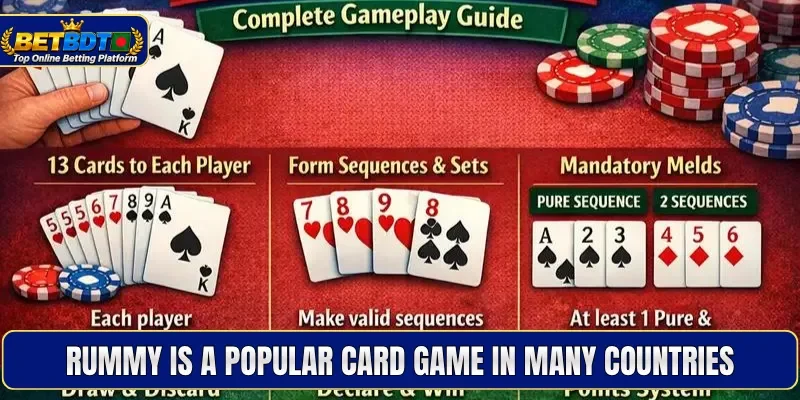
One of the most widely played versions is game, which typically uses two standard decks, including printed jokers. Each player receives 13 cards and takes turns drawing and discarding cards to build valid combinations.
The game requires more than simply collecting matching cards. Players must recognize useful sequences, decide which cards to keep, and observe the cards discarded by opponents. These decisions make every round different.
Basic rules of Rummy
Before starting a game, players should familiarize themselves with the basic rules. They should also learn the different card combinations.
Understanding card combinations
Rummy features two main types of card combinations. The first is called a sequence. The second is known as a set.
- Sequence: Three or more consecutive cards of the same suit. For example, 4♥, 5♥, and 6♥ form a valid sequence.
- Set: Three or four cards with the same rank but different suits. For example, 8♠, 8♥, and 8♦ form a valid set.
A valid declaration in Indian 13-card generally requires at least two sequences, including at least one pure sequence. The remaining cards must also form valid sequences or sets.
Pure and Impure Sequences
Sequences are divided into two main categories. Each type follows specific rules for arranging cards. Understanding these differences helps players form valid combinations.
- Pure sequence: A group of three or more consecutive cards of the same suit without using a joker. Example: 7♣, 8♣, and 9♣.
- Impure sequence: A sequence that uses a joker to replace a missing card. Example: 5♦, 6♦, and Joker, where the joker represents 7♦.
The role of Jokers
Jokers are special cards that can substitute for other cards when forming combinations. Most Indian Rummy games include printed jokers and a randomly selected wild joker.
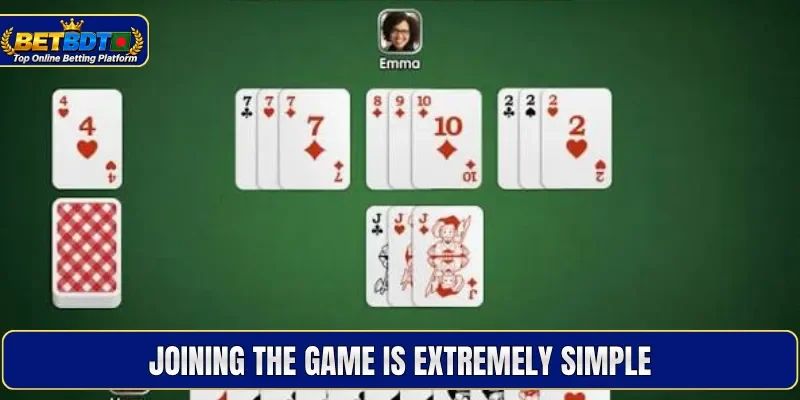
A wild joker is determined at the beginning of a round. Depending on the rules, cards of the same rank as the selected wild card may also act as jokers. Jokers can help complete impure sequences and sets. However, they cannot replace a card in a pure sequence.
How to play Rummy step by step
The gameplay follows a repeating draw-and-discard process. Each player takes one turn at a time until someone makes a valid declaration.
Step 1: Deal the cards
In Indian 13-card Rummy, each player receives 13 cards. The remaining cards are placed face down to form the closed deck. One card is placed face up to start the open discard pile.
Step 2: Draw a card
Choosing the right card can help complete a sequence or set. At the beginning of each turn, a player picks one card from either:
- Closed deck: A face-down pile containing unknown cards.
- Open deck: A face-up pile containing cards discarded by previous players.
Step 3: Arrange your combinations
After drawing a card, organize the hand into possible sequences and sets. Keep useful consecutive cards together and identify cards that may help complete unfinished combinations. For example, holding 6♠ and 7♠ creates an opportunity to form a sequence by collecting either 5♠ or 8♠.
Step 4: Discard one card
After drawing, the player must discard one unwanted card into the open pile. This keeps the hand at 13 cards and allows the next player to continue. Avoid discarding cards that opponents may need. Observing previous discards can help you make more informed choices.
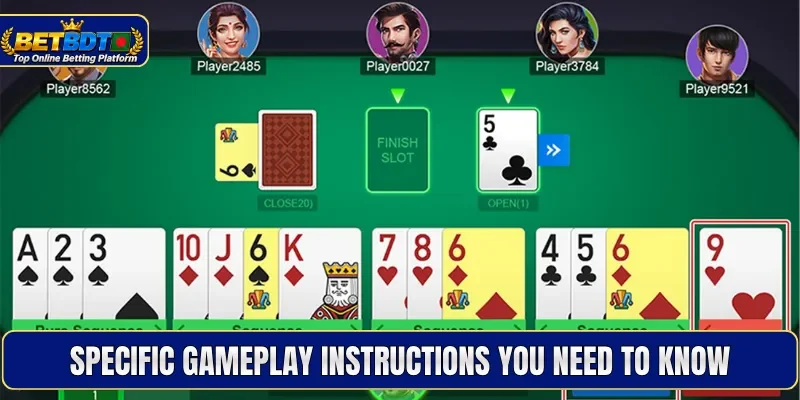
Step 5: Declare when your hand is valid
Once all 13 cards are arranged into valid combinations and the required sequence conditions are met, a player can declare game according to the platform’s rules. The declaration is then checked. If all combinations are valid, the player wins the round. An invalid declaration may result in a penalty.
Rummy scoring system
In many Indian Rummy formats, scoring is based on the unmatched cards remaining in a player’s hand when another player makes a valid declaration. Number cards generally carry their face values, while face cards such as Jack, Queen, and King carry 10 points each. Aces are commonly valued at 10 points, although specific rules may vary.
| Card | Typical point value |
| 2 – 10 | Face value |
| Jack | 10 |
| Queen | 10 |
| King | 10 |
| Ace | 10 |
| Joker | 0 |
For example, if a player has an unmatched King, 8, and 4 when the round ends, the total penalty is 22 points. Valid sequences and sets do not contribute to the penalty score. Jokers also carry zero points in standard scoring calculations.
Common types of cards in the game
Game comes in several different variations. Each version features its own rules and gameplay mechanics. This variety gives players more ways to enjoy the game.
| Variation | Main characteristics |
| Indian | Usually 13 cards per player and requires at least two sequences |
| Gin | Commonly played by two players using 10 cards each |
| Points | Each round is scored using points with a predetermined value |
| Deals | Players compete across a fixed number of deals |
| Pool | Players try to avoid reaching a specified penalty-point limit |
Indian Rummy focuses on completing sequences and sets, while Gin emphasizes reducing unmatched card values. Points, Deals, and Pool formats introduce different scoring structures and round objectives.
Conclusion
Rummy becomes easier to understand when players master its card combinations, drawing and discarding rules, and scoring system. Learning how to build valid sequences, use jokers wisely, and observe opponents can also improve overall gameplay. Whether you are new to the game or looking to sharpen your skills, visit BETBDT to discover engaging card games and start exploring today.